
What You Can Customize in Custom Digital Watch Manufacturing for a Private Label Brand
Almost every part of a digital watch can be made to fit your brand. The ways to customize it fall into five groups: design, functionality, branding, compliance, and commercial terms. You own the brand, not the factory, so your custom digital watch manufacturer builds to your specs. This guide treats each group as a working checklist for a private label watch program. You will see real examples for every group. You will also learn the exact information a factory needs to quote your project. That includes your target quantity, design references, materials, movement type, feature list, logo and packaging requirements, and destination market. Whether you plan a basic white-label smart watch or a full customization project, each section shows what to specify and what to send.
Customize design parts like the case, dial, and strap to match your brand vision.
Pick the functions and features that match your target market and sales channel.
Put your logo on the dial, caseback, and packaging so people know your brand right away.
Ask for compliance certifications like ISO 9001 and RoHS to make sure you can enter the market.
Every part of the watch you can see can show your brand: the case, bezel, dial, hands, crown, caseback, strap, and buckle. You pick the materials, finishes, and colors. Your factory then makes each piece to match. This is where a private label watch starts to look like a real brand product instead of a generic item.
The case makes the first impression. You can choose 316L stainless steel, which resists rust and is widely trusted by buyers. Titanium gives you a lighter option that is less likely to cause allergies. The surface finish changes the feel of the watch. Brushed finishes look subtle and modern. Polished finishes catch the light and suggest luxury. Sandblasted finishes give a matte look you can feel.
The bezel gives you another surface for branding. Ceramic bezels hold their color better over time than PVD-plated options. That makes them a strong fit for heritage or sport branding.
The caseback is worth your attention. Deep engraving, laser-etched details, and custom medallions can carry company slogans, symbolic imagery, or special edition numbers. A laser-engraved logo, serial number, and spec marks cost very little at production time. Serial numbering helps a young brand feel established. The crown and clasp can each carry an engraved or stamped mark for extra branding.
|
Component |
Customization Options |
|---|---|
|
Case |
316L stainless steel or titanium; brushed, polished, or sandblasted finishes |
|
Bezel |
Ceramic bezels with strong color fidelity for heritage or sport branding |
|
Caseback |
Deep engraving, laser etching, custom medallions, logo, serial number, spec marks |
The dial is your billboard. You can pick custom dial colors and layouts, then place your logo exactly where you want it. Hands work the same way. Shape, color, and finish should support the overall look of your watch collection.
Straps and buckles complete the design. Material and color choices range widely, and branded buckles add a finishing touch. A leather strap suits a dress watch. A resin or silicone strap fits a sporty smart watch. Each choice should serve the brand vision you set at the start.
Your design team has two paths. You can adapt an existing style, or you can develop a new mold for a full custom shape. An established custom digital watch manufacturer may offer a wide range of base styles to start from. That range shortens development time and lowers risk. Many private label watch manufacturers also support full customization from sketch to sample, so your design capabilities grow with your line.
Whether you launch a white-label smart watch or a fully customized model, the goal stays the same. Every component should be customized to suit your brand vision. Strong design capabilities turn that goal into watch collections that buyers recognize on the shelf.
Function decides which market your product fits. You pick the module, the movement, and the feature list. Each choice fits a different group of buyers, so match the build to your sales channel instead of chasing every feature.
Begin with the module. Quartz modules keep a private label watch low in cost and dependable for high-volume programs. Automatic movements fit higher-tier lines where buyers value mechanical character. For a smart watch, the module holds the sensors. You can choose PPG optical heart rate arrays, accelerometers, gyroscopes, GPS modules, SpO2 sensors, ECG electrodes, temperature sensors, and bioimpedance sensors. The display choice matters too: AMOLED, LCD, e-ink, or a screenless design each fits a different use case.
Feature sets follow the same logic. Heart rate, blood pressure, and sleep tracking fit health-focused buyers. Waterproofing and shockproofing suit sports channels. Night vision with cold light suits outdoor and tactical segments. A talking watch serves accessibility markets. Every feature you add raises unit cost, so specify only what your segment needs.
Software turns hardware into a branded experience. You can rename the Bluetooth identifier, set the boot logo, and add custom UI elements that match your identity. Language support, dial logos, and customizable UI themes all fall within firmware scope. A private label service can also build a companion app for iOS and Android, or connect your watch to an existing app through its Bluetooth protocol.
Firmware customization depends on the chosen hardware. Your manufacturer assesses firmware and UI work as part of project scope, and confirms feasibility during an early technical review. Full source-code access is not guaranteed for every model, so verify this before you commit. A white-label smart watch often ships with a ready app you can brand. A deeper build lets you customize it to your needs, including algorithms and API access. Treat each wearable device project as a feasibility question first, then a development plan.
Yes, you can put your own logo on a digital watch. The dial, caseback, crown, buckle, and strap can all carry your mark. Adding your logo is the quickest way to make a watch that really shows off your brand image.
The dial has the logo people see first. You can add a logo, color, pattern, or texture to the dial surface. Caseback engraving works well for a brand name, event, or dedication. Hands, crown, and bezel can be made in the colors you pick. Send vector logo files (.AI, .EPS, or .SVG) along with Pantone or HEX color codes. Private label watch manufacturers use these files to set up production tooling.
On a smart watch, the firmware boot logo shows up at startup. Your firmware also controls the splash screen, menu icons, and language. A private label smart watch firmware can show your mark on every screen. Ask your factory to confirm firmware access before you commit. Firmware changes need a technical review.
Packaging carries your branding past the case itself. Custom watch boxes display your logo or message. Special edition markings and certificates of authenticity add value. User manuals and labels use the same artwork. Plan on a minimum order quantity of 100 units and about 45–60 days of production after design approval.
OEM/ODM support lets private label watch manufacturers handle logo application and packaging development from start to finish. A private label service team reviews artwork, proofs samples, and manages final assembly. This private label services model fits white-label and white-labeling programs. Private label smart watches and classic private label watch lines both gain from it. Ask private label watch manufacturers for a packaging sample. A white-label smart watch can still carry full private label branding. A private label watch launch goes faster with one partner. Every private label watch program needs clear artwork approval. Private label buyers expect the same marks on every unit. Private label success depends on repeatable production. Customization like this turns a generic smart watch into your product.
Compliance decides if your watch can enter a market at all. Buyers usually ask for proof of quality management and material safety before they order. Experienced private label watch manufacturers keep these documents and share them in your project file.
ISO 9001 covers the factory's quality management system. A certified plant follows written procedures, and auditors check those processes against international standards regularly. This certification shows that the production line follows a repeatable process, not a one-time effort.
Material safety certificates matter just as much. RoHS and REACH show up in compliance documents for production batches. CE and RoHS test reports come as project documents, and you confirm the applicable model, test scope, and compliance requirements for each order. An EMC test report is part of the CE evaluation file.
|
Certification / Compliance |
What It Covers |
|---|---|
|
ISO 9001 |
Certified quality management system, audited to international standards |
|
RoHS |
Material safety certificate supplied with batch documentation |
|
REACH |
Material safety certificate supplied alongside RoHS |
|
CE / CE EMC |
Test reports issued per order, with model and scope confirmed |
Quality control runs through the whole production cycle. Checks happen at incoming material inspection, case machining, assembly, and final testing. Visual inspections, dimensional checks, and functional tests catch defects early. Typical OEM tests cover timekeeping, water resistance where applicable, and functions such as date, chronograph, or GMT per your specification.
Pre-shipment final testing repeats the timekeeping, water-resistance, and appearance checks before packing. Optional extended tests, including shock and long-term running checks, support the claims you plan to market. For export, your manufacturer supplies CE and RoHS documentation and protects your design rights. Ask any private label service partner for the test reports tied to your exact model. A white-label smart watch still needs the same paperwork, and firmware changes may require a fresh EMC review. Confirm that scope early with your private label watch manufacturers. Solid documentation keeps a white-label launch on schedule and protects your private label watch in every destination market.
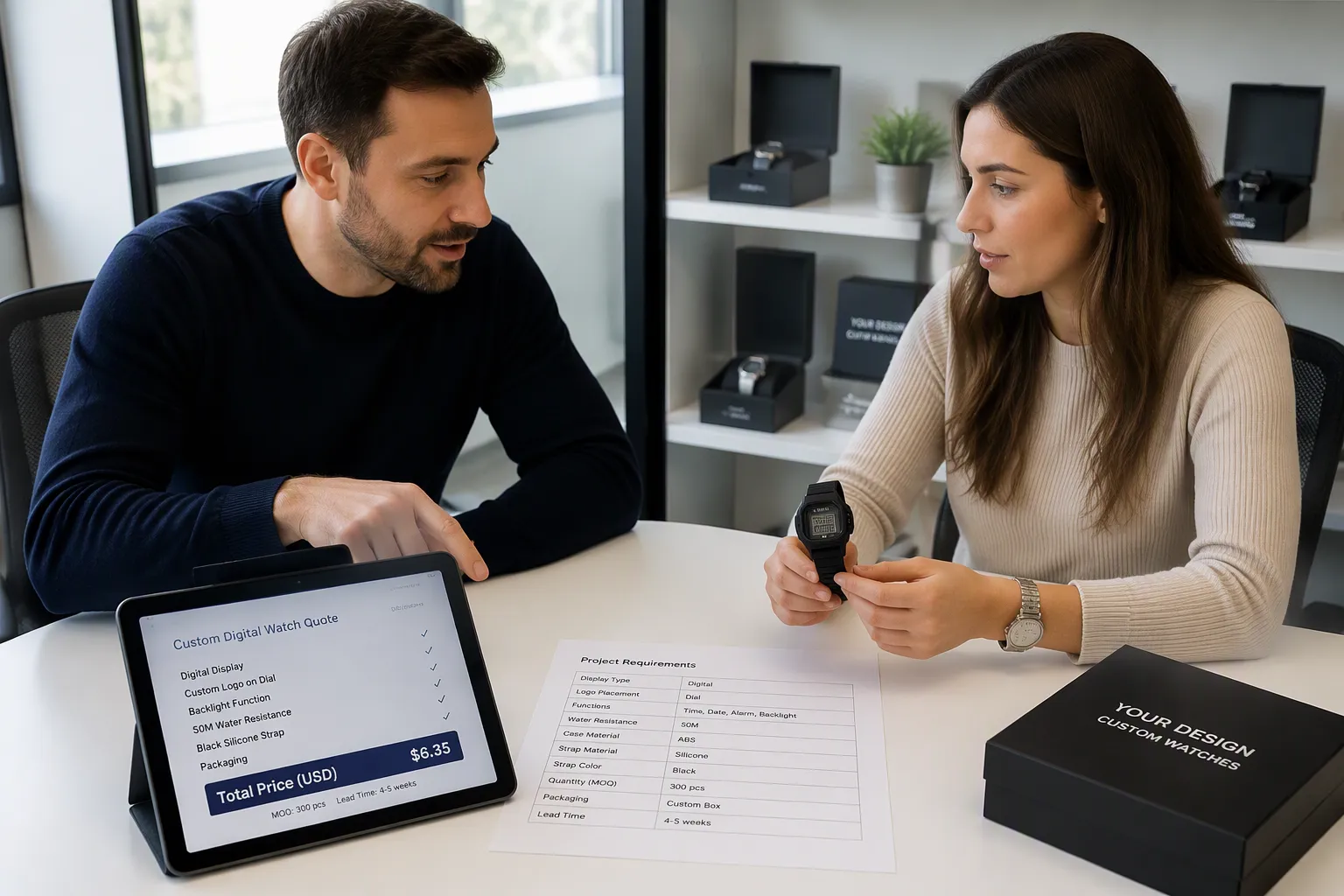
Order size shapes your whole project. Minimum order quantities for custom watch manufacturing can start as low as 50 pieces. Pricing then scales by volume, materials, and feature complexity. A small first run lets you test a market with limited risk. A larger run lowers your unit cost and supports a broader launch.
A low entry point changes how you plan. You can start with 50 pieces, confirm demand, and reorder at higher volume. Volume moves unit price in your favor, so treat the first order as a test and the second as a scale-up. Materials and feature complexity also shift the price. A basic digital model with a standard module costs less per unit than a build with sensors, cold light, or a custom mold.
Lead time follows the same logic. Simple builds move faster than complex ones. Custom tooling, new molds, and packaging development add time before mass production begins. Ask your custom digital watch manufacturer for a timeline tied to your exact specification, not a generic estimate. A private label watch program with clear specs and approved artwork avoids delays at every stage.
A complete specification produces an accurate quote. Send the factory your watch type, case size, movement, case material, strap material, dial design, logo requirements, water resistance rating, estimated quantity, and packaging requirements. A more complete specification enables the manufacturer to produce a more accurate quotation.
|
Requirement category |
Details the factory needs |
|---|---|
|
Watch type |
Type of watch being requested (e.g., digital) |
|
Case size |
Dimensions of the watch case |
|
Movement |
Movement type/caliber |
|
Case material |
Material of the case |
|
Strap material |
Material of the strap/band |
|
Dial design |
Design of the dial |
|
Logo |
Logo/branding requirements |
|
Water resistance |
Required water resistance rating |
|
Estimated quantity |
Expected order volume |
|
Packaging requirements |
Packaging specifications |
Attach design files where you have them. CAD or 3D drawings, 2D technical drawings, a tech pack, or reference images all help. One attachment is enough to start, and the factory accepts common file formats. State your estimated order quantity in a band, such as under 500 pieces or 500–1,000 pieces. Add a short message with any details the files miss.
Material choice drives unit price directly. A 316L stainless steel case costs more than a resin case, and the finish adds labor. Module selection matters just as much. A quartz module keeps cost low, while a sensor-rich module for a smart watch raises it. Packaging complexity adds a third layer. A plain box costs less than a fully branded retail package with manuals and inserts.
Firmware scope belongs in the quote too. Ask whether firmware changes are included, since firmware work on a smart watch needs a technical review. A white-label model often ships with standard firmware you can brand. A deeper build may need custom firmware development. Confirm firmware access and firmware testing before you sign. Your private label service partner should list firmware costs as a separate line.
Compare quotes from two or three private label watch manufacturers on the same spec sheet. Ask each one how quality control and customization affect the final price. A white-label route suits a fast launch, and full private label services suit a longer build. Either path works when your specification is complete.
You can customize five areas of a digital watch: design, function, branding, compliance, and commercial terms. Begin with a few choices that make a big difference. A custom logo on the dial and a branded box help a private label launch more than a new mold does. Add firmware features and deeper design work as your volume grows.
Next, make a spec sheet using the quoting checklist above. Write down your quantity, materials, features, logo files, and packaging needs. Then ask two or three private label watch manufacturers for quotes. Compare how each one handles firmware scope and quality control.
Treat the first order as a test. A repeatable private label program makes each launch faster and smoother.
Yes. Your logo can go on the dial, caseback, crown, buckle, and strap. Send vector files in .AI, .EPS, or .SVG format with Pantone or HEX color codes. The factory uses these files to set up the tools for production.
Custom watch manufacturing can start at just 50 pieces. Custom packaging usually needs at least 100 units. Price goes down as volume goes up, and materials and features also change the cost. A small first run lets you test demand before you scale up.
Plan on about 45–60 days of production after design approval. Simple builds go faster than complex ones. Custom tooling, new molds, and packaging development add time before mass production starts. Ask for a timeline that matches your exact specification.
Not always. A white-label smart watch often comes with a ready app you can brand. A deeper build lets you customize the interface, language, and companion app. Confirm firmware access and feasibility during an early technical review before you commit.
Ask for ISO 9001 for quality management, plus RoHS and REACH for material safety. For European markets, request CE and EMC test reports tied to your exact model. Confirm the applicable model and test scope for each order.